
Eat fruit immediately after meals cause stomach bloating?
Recently, a well-known Malaysian TV station published a health knowledge post on social media, mentioning that eating fruit immediately after meals will cause stomach bloating. Is this knowledge about health correct?
Found to be: Inaccurate
Studies have shown that eating fruit immediately after a meal does not cause bloating. The fiber and water in fruit increase satiety and help reduce energy intake for subsequent meals. The sugar and nutrients in the fruit are uniformly absorbed by the body, without affecting blood sugar and hormones.
The digestion time of the main meal varies with the type of food and the individual's digestive capacity, and is not fixed at two hours. Liquid foods are digested faster, while solid foods take longer. Individual differences also affect the rate of digestion.
Normally, the acidic environment of gastric acid inhibits microbial growth and prevents fruit from fermenting in the stomach. The main digestion process of fruit in the stomach is carried out by gastric acids and digestive enzymes, which quickly pass through the stomach and are absorbed in the intestines.

Published at Oct 10, 2024

Background Cases
In modern health and nutrition topics, there has been a lot of discussion and advice about when and how to consume fruits. On May 30, 2024, 8tv Malaysia, a well-known television station in Malaysia, uploaded a health trivia post on Facebook and Instagram titled: "Health trivia you absolutely did not know". One of the infographic of the health trivia advocates that "it is not appropriate to eat fruit immediately after a meal", the digestion time of the meal takes about 2 hours, if you eat fruit immediately after a meal, the fruit will stay in the stomach to ferment, resulting in stomach distention. There is no research report or medical certificate attached to this post.
● Digestion time: One of the main points of this post is that meals take a long time to be fully digested, usually about two hours. The basis is that complex mixed meals take longer to digest through the stomach and small intestine.
● Fruit fermentation: Another key argument is that fruit contains a lot of sugar and water, which, if consumed immediately, may remain in the stomach and ferment, producing gas and bloating discomfort.
As of July 14, 2024, this post has accumulated 46 likes and 17 shares on FaceBook; Although Instagram can't show the number of retweets, but it has accumulated 2,300 likes.


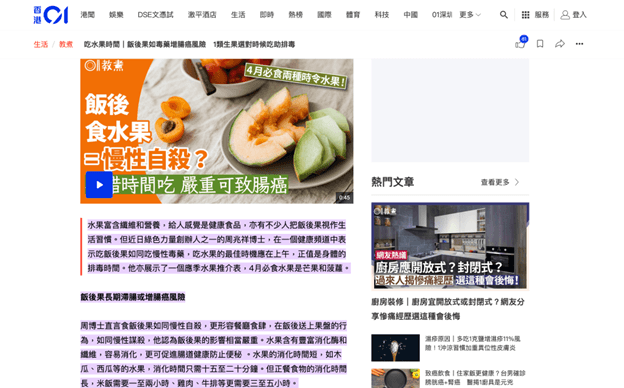
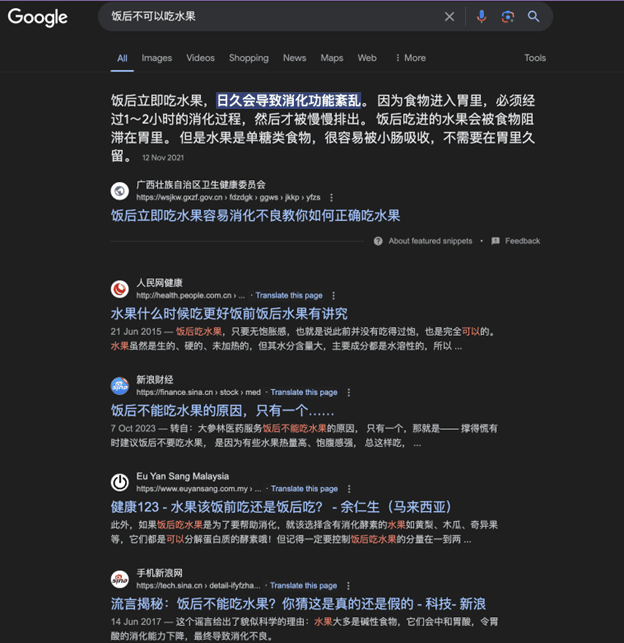
Although the reach rate and the number of shares of this post are not very high, I found through Internet search that this problem has existed for many years and it is still misunderstood by everyone, and even influential people also said in an interview on a Health channel [Health Code] that eating fruit after dinner is like chronic suicide.

[Check point 1: Will eating fruit immediately after meals cause stomach bloating?]
For many years, a belief has spread around the world that fruit should not be eaten immediately after the meal. This claim claims that the digestion of a full meal takes about two hours, and if fruit is eaten during this time, it ferments in the stomach, causing bloating and indigestion. This view has been widely circulated on various health blogs and social media, attracting public attention. But is there any scientific basis for this claim? According to a Research paper published in the <International Journal of Environmental Research and Public Health> in November 2019, The composite satiety score (CSS) of eating fruit before meals is significantly higher than that of eating fruit after meals and without fruit, because the fiber and water in fruit can rapidly increase the volume of stomach contents, thereby increasing satiety. In addition, energy intake was reduced by 18.5% in the pre-meal fruit, possibly because increased satiety in advance reduced intake at subsequent meals. Regarding blood sugar and hormone changes, studies have shown that changes in blood sugar levels and related hormones (such as GLP-1) do not differ significantly between different ingestion sequences. This shows that whether you eat fruit before or after a meal, the sugar and nutrients in fruit will be evenly absorbed by the body, and will not have a significant impact on blood sugar and hormones. Therefore, these results do not support the claim that eating fruit immediately after a meal causes bloating, but rather suggest that fruit intake in moderation is beneficial to health.
Betty Jian, a campus nutrition instructor at Cancer Care Foundation, said on her personal YouTube channel that fruit can be eaten at any time, but from a nutritionist’s perspective, it is more recommended to eat between meals, such as: eating fruit between breakfast and lunch or lunch and dinner to keep our blood sugar stable, while also providing fiber and vitamins to prevent eating less nutritious foods.
Taiwan FactCheck Center also verified on January 2, 2019 that the erroneous health knowledge transmitted by this post, and also confirmed that there is no such statement in nutrition at present, and stomach distention may occur because the gastrointestinal tract can not digest quickly caused by eating too much, and a large amount of food is stored in the stomach, leading to flatulence.
[Check point 2: Is it true that the digestion time for the main meal is about two hours?]
Not necessarily, the digestion time of food in the stomach depends on the type of food and the digestion capacity of the individual. The main function of the stomach is to mix food and begin the digestive process. When food enters the body, it is gradually broken down and absorbed through a series of digestive organs. First, the food is chewed in the mouth and mixed with the saliva to form bolus, and the amylase in the saliva begins to break down carbohydrates. The bolus are then pushed into the stomach through the peristaltic movement of the esophagus. In the stomach, food is further broken down by gastric acids and digestive enzymes to form chyme, and proteins begin to be broken down by pepsin. Chyme then enters the small intestine, where, under the action of bile and pancreatic fluid, fats, proteins, and carbohydrates are further broken down into absorbable nutrients, and the villi and microvilli of the small intestine increase the surface area and facilitate nutrient absorption. The unabsorbed residue passes into the large intestine, where water is reabsorbed to form feces.
Eventually, feces are excreted through the anus. The entire digestion process takes about 24 to 72 hours, depending on the type of food and the individual's ability to digest. According to the [Disorders of Gastrointestinal Motility], the study shows that the stomach empty time varies according to the food type and composition: liquids are usually half emptied within 20 minutes, while solid foods require more time for gastrointestinal digestion and pulverization, and then have a longer time to enter the intestine. Carbohydrate foods usually drain in 1 to 2 hours, protein and fat take longer, mixed meals may take 3 to 4 hours, and not all foods are given a fixed 2 hours to digest. In addition, individual differences can also affect the speed of digestion, including individual differences in age, sex, health and eating habits. Therefore, the digestion time is two hours for the main meal is not accurate highlights the important influence of individual differences and food types on digestion time.
[Check point 3: Will fruit ferment in the stomach?]
In order to verify the claim that fruit ferments in the stomach, we need to understand the digestive process in the stomach and the effect of pH on microbial activity. According to a study published in 2005 in <Applied and Environmental Microbiology>, under normal physiological conditions, the pH of gastric acid is between 1.5 and 3.5. This highly acidic condition inhibits the growth and fermentation process of most microorganisms. Gastric acid is indeed effective in preventing microbial overgrowth at pH levels below 4. As Raw Food Explained in The article "Why Fruits Are The Ideal Source Of Carbohydrates" : “they don’t need enhancement and they digest so easily and quickly, eaten with each other or alone, that fermentation and the resulting toxicity of fermentation is unlikely to occur." The sugars in fruits are mainly monosaccharides, and the main digestion process in the stomach is carried out through the action of gastric acids and digestive enzymes, rather than fermentation. The fruit passes through the stomach quickly and is absorbed in the intestines without the need for complex digestion. This further reduces the likelihood of the fruit fermenting in the stomach.
Fermentation is a decomposition process caused by microorganisms that takes place primarily in the large intestine, where food usually leaves the stomach within one to four hours, making it difficult for microorganisms to survive and ferment in the highly acidic environment in the stomach. Authoritative medical research has shown that the main role of gastric acid is to break down food and kill bacteria that enter the stomach, thereby preventing the occurrence of microbial activities such as fermentation. Therefore, the idea that fruit ferments in the stomach does not correspond to the actual situation of gastrointestinal physiology.
Conclusion
Disseminating misleading information about health and nutrition because it not only misleads the public, but can also have harmful effects on people's health and behavior. The wrong health advice can lead to unnecessary panic, wrong eating habits, and even health problems. For example, misleading information about eating fruit after meals can cause bloating may discourage people from eating fruit after meals, thus missing out on the nutritional benefits of fruit. Spreading this message is not just a matter of science, it is a matter of morality. We all have a responsibility to ensure that the information we disseminate is accurate, so as not to mislead our relatives and friends around us and even the general community.
After summarizing the above check points, eating fruit immediately after the meal will not cause bloating, in fact, moderate intake of fruit is beneficial to health. In addition, the digestion time of the main meal is not fixed for two hours, but depends on the type of food and the digestion capacity of the individual. Claims that fruit ferments in the stomach also lack scientific support, as the acidic environment in the stomach inhibits the growth of microorganisms and thus prevents fermentation. Therefore, eating fruit immediately after a meal will cause stomach bloating is wrong information.
References
Read more:
Article review